
Ball pythons are native to West and Central Africa where they live in grassland savannas and wooded areas. These excellent tree climbers prefer to be terrestrial and spend the majority of their time in abandoned burrows only coming out to bask in the sun or hunt for food.
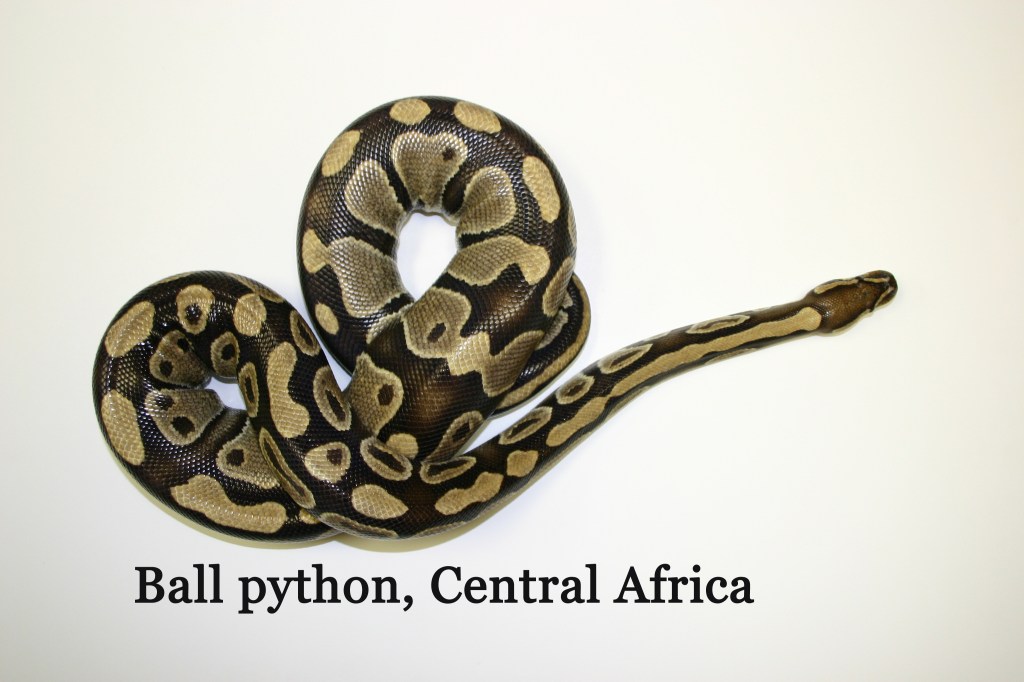
They get the first part of their name, “ball,” from their tendency to curl up into a tight ball when they feel threatened. When this happens they will also tuck their head’s towards the center.
Ball pythons are also called Royal pythons for members of African tribal leaders who would wear these majestic snakes as live jewelry.
The ball python is the smallest species of python found in Africa, averaging between 3-6 feet long with females being slightly larger and heavier-bodied than males. The largest python species in Africa, the African rock python, can reach up to 20 feet in length.
In the wild, ball pythons have a variety of food options including birds, small mammals and occasionally small reptiles. They kill their prey by constricting their coils around whatever they have captured and then consuming it with the help of 100-150 curved teeth.
These nocturnal snakes like many other members of the snake family Colubridae, have a special heat sensing organ that can detect infrared radiation. Located above the upper jaw this sense organ helps them sense the location of their prey.
While ball pythons are predators, they are also prey to many animals like birds of prey, wart hogs, leopards and humans. Ball pythons are listed as “least concern,” but they are still threatened by local tribes who use them for food and their skins, habitat loss, and being captured and sold into the pet trade.
The El Paso Zoo has Tiger Eye, a 24-year-old female ball python who is an conservation ambassador for all savanna animals in Africa.

Special thanks to Ricardo Rosales for his help with this blog post.
Top two photos by Rick LoBello.
 Conservation Education